UTM Tracking in a Privacy-First Era: What Still Works in 2026
Learn how Apple ATT, Link Tracking Protection, browser privacy controls, and modern attribution challenges impact UTM tracking—and why campaign metadata remains critical in 2026.

Why UTM Tracking Feels Broken in 2026
The Old Promise of Attribution
For nearly two decades, marketers operated in a relatively stable attribution environment. Third-party cookies were widely available, browsers imposed fewer restrictions, and mobile tracking identifiers flowed freely between apps, websites, and advertising platforms.
When someone clicked an ad, analytics platforms could often connect that click to a conversion with a high degree of confidence. Marketing teams became accustomed to detailed reporting that answered questions such as:
- Which campaign generated the visit?
- Which ad creative drove the conversion?
- Which audience performed best?
- Which platform delivered the highest return on ad spend?
While attribution was never perfect, there were usually enough signals available to build a reasonably complete picture of the customer journey.
Why Attribution Feels Harder Today
Fast forward to 2026, and many marketing teams feel like their reporting has become less reliable.
Common symptoms include:
- Growth in Direct traffic
- Increases in Unassigned traffic within GA4
- Larger discrepancies between advertising platforms and analytics tools
- Missing campaign attribution
- Reduced visibility into cross-device journeys
These changes can be frustrating, particularly when campaign performance appears healthy inside an advertising platform but looks much weaker within website analytics.
The reality is that attribution hasn't necessarily become worse—it has become more constrained.
Privacy protections are intentionally reducing the amount of user-level information available for measurement, making it more difficult to connect every click, visit, and conversion across devices and platforms.
The Growing Disconnect Between Platform Reporting and Analytics
One of the most common questions marketers ask today is:
"Why does Meta say I generated 200 conversions while GA4 only reports 130?"
The answer often comes down to differing attribution methodologies and data availability.
Advertising platforms frequently have access to:
- First-party platform data
- Modeled conversions
- Logged-in user behavior
- Proprietary identifiers
Analytics platforms, on the other hand, only have access to the information that successfully reaches your website and can legally be stored based on consent settings.
As privacy protections continue to evolve, this disconnect is likely to become even more pronounced.
What Privacy Systems Are Actually Blocking
Understanding Link Decoration
Link decoration refers to the practice of adding tracking information directly to URLs.
Common examples include:
https://example.com/?gclid=123abc
https://example.com/?fbclid=456xyz
https://example.com/?ttclid=789def
These identifiers are typically appended automatically by advertising platforms to help connect ad clicks with subsequent activity on your website.
Historically, these parameters allowed platforms to create a rich attribution picture by connecting user actions across different environments.
However, because they can also facilitate user-level tracking, they have become a target for privacy-focused initiatives.
Apple's Link Tracking Protection
Apple's Link Tracking Protection (LTP) has significantly changed how certain identifiers behave.
Introduced as part of Apple's broader privacy strategy, LTP removes selected tracking parameters when users interact with links in specific contexts, including:
- Safari Private Browsing (opt-in privacy mode)
- Mail app
- Messages app
Parameters that are affected in these contexts include:
gclid(Google)dclid(Google Display Network)fbclid(Facebook)ttclid(TikTok)
From Apple's perspective, these identifiers can be used to track individuals across websites and applications.
From a marketer's perspective, their removal can make attribution more difficult because analytics systems lose access to valuable click-level information before the user even reaches the destination site.
📍 Progress Check: The impact is meaningful but limited to specific contexts. In regular browsing mode, gclid parameters remain intact by default unless users manually enable 'Tracking & Fingerprint Protection' for all browsing in Safari settings. Safari Private Browsing is opt-in and represents roughly 15-20% of iOS users who actively choose privacy mode.
Browser Privacy Protections Continue Expanding
Apple is not alone.
Modern browsers increasingly implement technologies designed to reduce cross-site tracking and limit persistent identifiers.
Examples include:
- Intelligent Tracking Prevention (Safari)
- Enhanced Tracking Protection (Firefox)
- Bounce Tracking Mitigation
- Third-party cookie restrictions
- Privacy Sandbox initiatives
Although the specific implementation details vary, the direction is clear:
The web is steadily moving toward a future with fewer user-level tracking signals.
Note on iOS 26: Apple has signaled potential expansion of Link Tracking Protection beyond Mail, Messages, and Private Browsing, but current testing shows click IDs still pass through in regular Safari browsing. The final implementation remains pending.
The Critical Distinction: Identity Signals vs. Campaign Metadata
Understanding this distinction is essential for modern attribution.
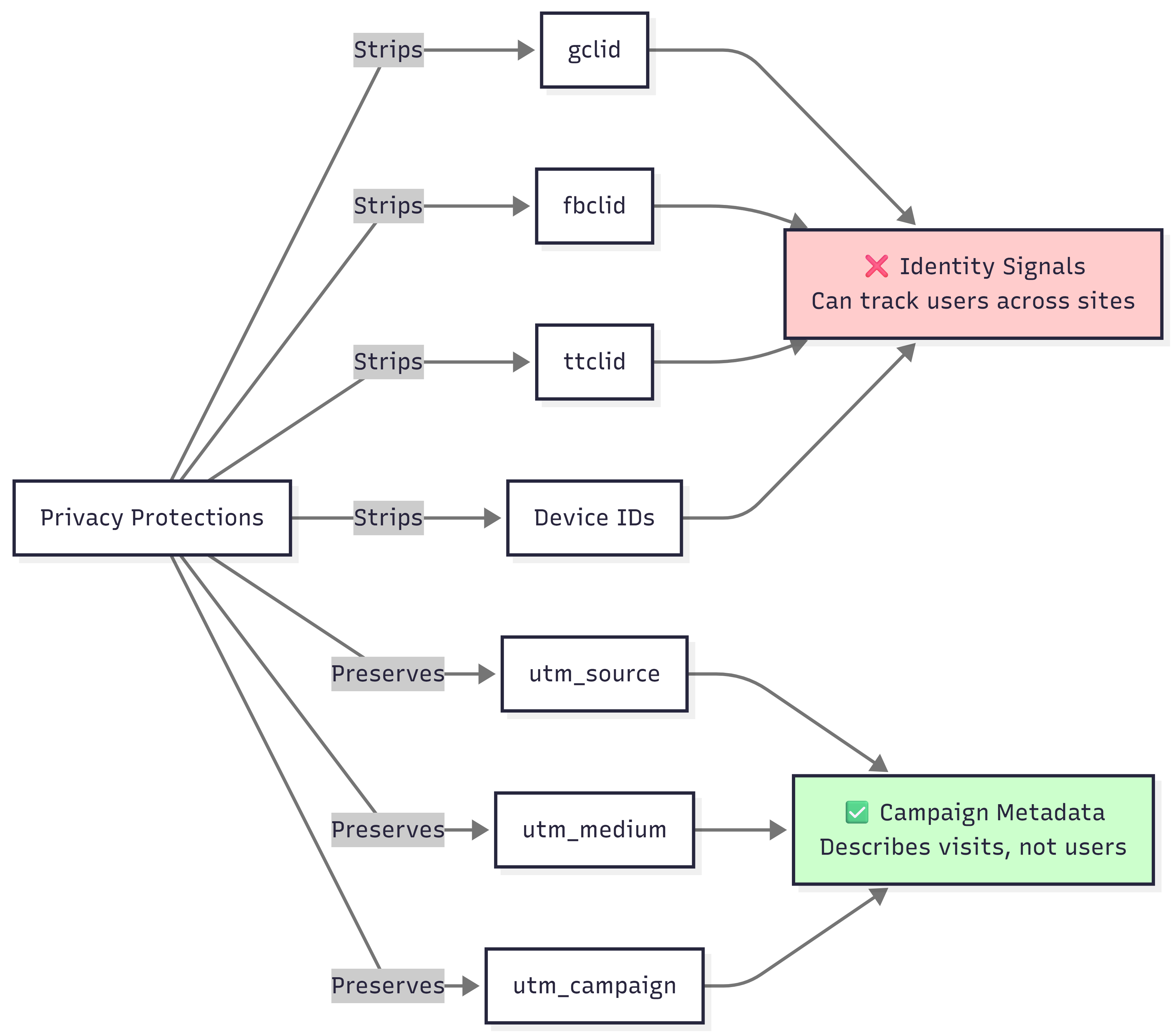
Privacy systems primarily target identity signals.
Examples include:
gclid(Google Ads)fbclid(Facebook)ttclid(TikTok)- Device identifiers
- User IDs
- Advertising IDs (IDFA, AAID)
These values are designed to help connect activity back to a specific person or device. They enable user-level tracking across websites and platforms.
Traditional UTM parameters serve a fundamentally different purpose.
Examples include:
utm_sourceutm_mediumutm_campaignutm_contentutm_term
These parameters describe campaign context rather than individual identity.
A UTM parameter can tell analytics systems:
- Which platform generated the visit (Facebook, Google, newsletter)
- Which campaign drove the click (spring-sale-2026)
- Which creative variation was used (hero-cta)
But it does not identify who the visitor is.
This distinction helps explain why privacy protections increasingly target click identifiers while largely leaving traditional UTM parameters untouched.
Why Manual UTMs Still Work
What UTMs Were Designed to Do
UTM parameters were never intended to solve identity resolution.
Their purpose has always been much simpler.
UTMs answer questions such as:
- Where did this visit come from?
- Which campaign generated the click?
- Which email or ad drove engagement?
- Which creative variation performed best?
These questions remain highly valuable regardless of broader privacy changes.
Why Data Quality Becomes Critical Now
When gclid and fbclid are available, GA4 has redundancy.
A malformed UTM might be overlooked because the platform identifier fills the gap.
But as click identifiers become less reliable, GA4's reliance on properly formatted UTMs increases.
Here's where it gets critical: GA4 enforces strict rules for channel grouping and refuses to guess when data is ambiguous.
Examples of what causes traffic to drop into "Unassigned":
❌ Case mismatch:
   utm_source=Facebook (should be: facebook)
   → Falls to Unassigned


❌ Typo in parameter name:
   utm_meduim=cpc (should be: utm_medium)
   → Parameter is ignored, missing medium = Unassigned

❌ Missing required campaign:
   utm_source=google&utm_medium=cpc
   (no utm_campaign)
   → May route to Unassigned depending on channel rules

❌ Parameters after fragment:
   ?utm_source=google#promo?utm_medium=cpc
   (UTM after # is invisible to GA4)
   → Falls to Unassigned
In the identity-rich world of 2020-2023, these mistakes were often recoverable.
In 2026, when you're relying entirely on manual UTM metadata to categorize traffic, a single syntax error cascades directly into your Unassigned bucket.
This is why data quality and pre-launch validation have shifted from "nice to have" to "essential operational requirement."
Why UTMs Are More Resilient Than Many Marketers Realize
Unlike platform-specific identifiers, UTM parameters are:
- Human-readable: You can see what they mean in the URL
- Platform-agnostic: Work across all advertising and analytics platforms
- Easy to audit: Simple to verify consistency in your tracking
- Focused on campaign context: Describe campaigns, not users
Because they identify campaigns rather than people, they generally avoid many of the privacy concerns associated with user-level tracking.
When a properly tagged URL reaches your website, UTMs still provide reliable campaign information that can support:
- Channel reporting
- Campaign analysis
- Content performance measurement
- Marketing optimization
- Multi-platform reconciliation
This is why UTMs continue to serve as the foundation of many attribution frameworks despite widespread changes in privacy regulations and browser behavior.
Critical: The Fragment Trap
⚠️ Fragment Identifier Warning
One common formatting mistake can render UTMs completely invisible to GA4:
Wrong order:
https://example.com#section?utm_source=google&utm_medium=cpc
                    ↑ Fragment comes first
                          ↑ UTMs after fragment = invisible to GA4
Correct order:
https://example.com?utm_source=google&utm_medium=cpc#section
        ↑ UTMs in query string                          ↑ Fragment last
Why this matters: Browsers don't send anything after the
#symbol to servers. GA4 only receives what comes before the fragment. If UTMs are placed after#, they never reach your analytics.In a privacy-first era where you're relying entirely on manual campaign metadata, this single formatting mistake can cause entire campaigns to appear as Direct / (none) traffic.
Manual UTMs vs. Auto-Tagging
Many organizations rely heavily on auto-tagging systems such as Google Ads' gclid.
Auto-tagging offers convenience and deep integration between advertising and analytics platforms.
However, it also introduces dependency on platform-specific identifiers that may become unavailable due to privacy protections.
The comparison is worth understanding:
| Aspect | Manual UTMs | Auto-Tagging (gclid, fbclid) |
|---|---|---|
| What it tracks | Campaign context | Individual user actions |
| Privacy risk | Low (campaign metadata) | High (user identifiers) |
| Platform dependency | None (universal) | High (platform-specific) |
| Privacy protection impact | Resistant | Vulnerable |
| Implementation | Manual setup required | Automatic |
| Platform visibility | Limited to GA4, server tracking | Deep platform integration |
| Reliability in 2026 | Still strong | Increasingly limited |
The strategic implication: Organizations benefit from using both. UTMs provide campaign context resilience; auto-tagging provides platform-specific insights while it remains available.
How Privacy Protections Changed Attribution in Practice
Real Impact: When gclid Disappears
Here's what actually happens when privacy protections strip identifiers:
Scenario 1: Apple Mail or Messages
User action: Clicks Google Ad link in Apple Mail
URL arrives at your site:
  https://example.com/?gclid=123abc&utm_source=google&utm_medium=cpc

What happens:
- Apple Mail strips: gclid=123abc
- Preserved: utm_source=google, utm_medium=cpc

In your analytics:
- GA4 cannot match to Google Ads (no gclid = no connection)
- But GA4 still knows: Traffic came from Google via paid search
- Channel grouping: Still shows as "Paid Search" ✅
- Campaign attribution: Still available ✅
Scenario 2: Safari Private Browsing
User clicks ad in Safari Private Browsing mode
URL arrives at your site:
  https://example.com/?gclid=123abc&utm_source=google&utm_medium=cpc

What happens:
- Safari Private Browsing strips: gclid=123abc
- Preserved: utm_source=google, utm_medium=cpc

In your analytics:
- GA4 cannot match individual conversion to Google Ads
- But GA4 still knows: Traffic came from Google via paid search
- Channel grouping: Still shows as "Paid Search" ✅
- Campaign attribution: Still available ✅
Scenario 3: Regular Safari Browsing (Current Behavior)
User clicks Google Ad in regular Safari
URL arrives at your site:
  https://example.com/?gclid=123abc&utm_source=google&utm_medium=cpc

What happens (as of 2026):
- Regular Safari: gclid passes through normally ✅
- UTMs preserved: utm_source=google, utm_medium=cpc ✅

In your analytics:
- GA4 matches click to Google Ads (gclid available) ✅
- Google Ads reports match GA4 ✅
- Full attribution works ✅

Note: Apple may expand parameter stripping to regular browsing in future releases, but current testing shows this behavior is not yet the default.
Scenario 4: Third-Party Cookie Deprecation
User visits: https://example.com/?utm_source=facebook&utm_medium=paid-social
Performs conversion

What happens:
- Third-party cookies can no longer track across sites
- First-party tracking may still work (depends on consent)
- UTM parameters are still recorded ✅

In your analytics:
- Attribution to Facebook campaign: Still works ✅
- Cross-site behavior before conversion: Lost (to privacy protections)
- Campaign performance: Still measurable ✅
The Results: What Attribution Looks Like Today
In a privacy-first era, attribution increasingly looks like this:
- ✅ Campaign-level reporting works reliably
- ✅ Channel performance is measurable
- ✅ UTM-based analysis is accurate
- ⚠️ Individual user journeys are incomplete
- ❌ Cross-device attribution becomes impossible
- ❌ View-through conversion tracking is limited
The shift: From user-level attribution → to campaign-level reporting.
The Role of Server-Side Tracking and First-Party Data
Why Server-Side Tracking Matters More Now
Client-side tracking (JavaScript tags in the browser) has become increasingly unreliable due to privacy protections.
Server-side tracking—where your server directly communicates with analytics platforms—offers greater resilience because:
- It operates before browser restrictions take effect
- It doesn't depend on third-party cookies
- It can implement first-party cookies more reliably
- It has access to data that never reaches the browser
However, server-side tracking still depends on campaign context.
If UTMs aren't properly tagged, server-side tracking has nothing to measure.
The Modern Attribution Stack
The most effective measurement approaches combine:
- Manual UTMs (campaign metadata foundation)
- Auto-tagging (while still available for deeper insights)
- Server-side tracking (resilient to privacy restrictions)
- First-party data (owned data that doesn't depend on identifiers)
A typical modern architecture may look like:
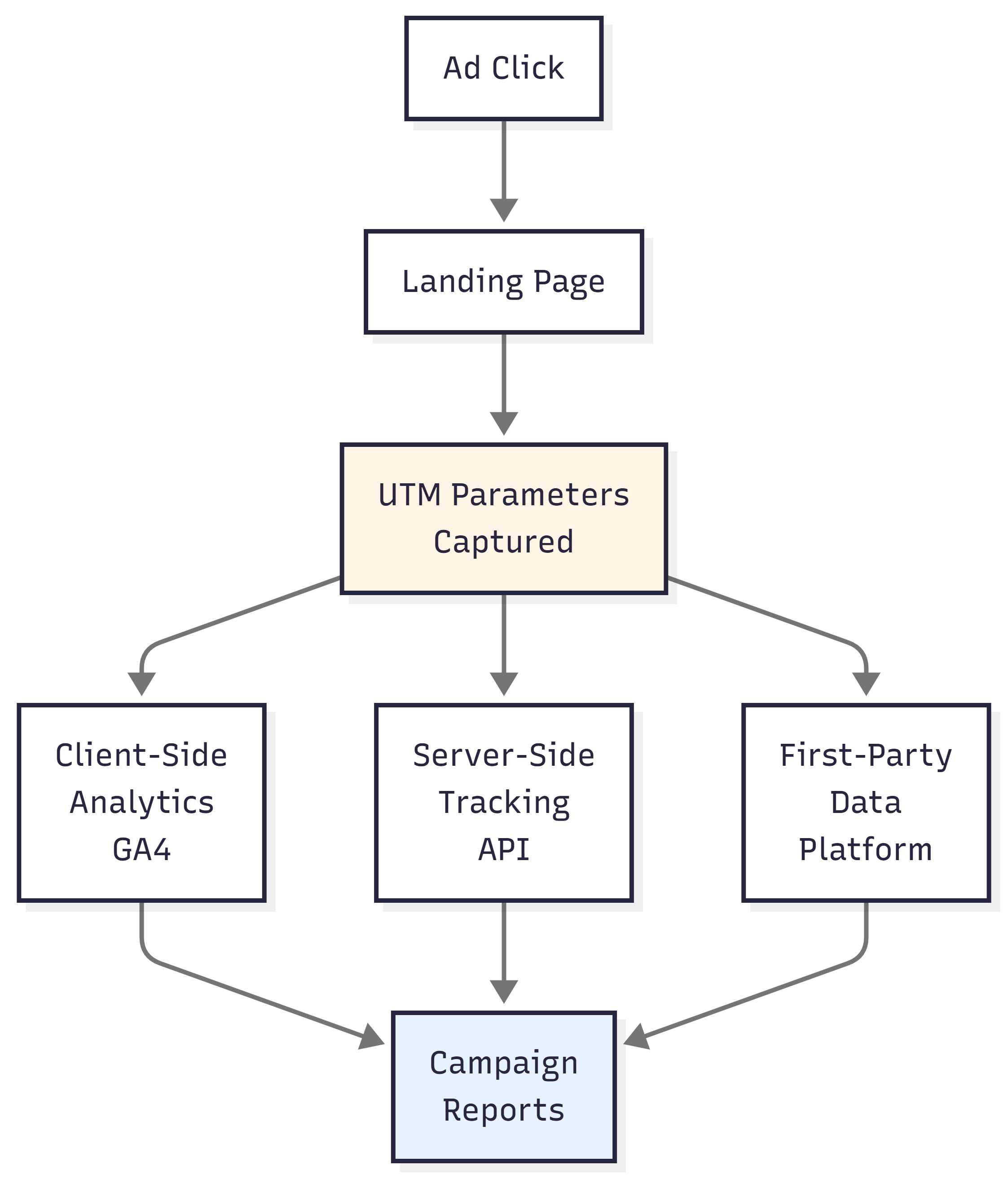
Key point: UTMs flow through every layer. They're the connective tissue that ensures campaign context is preserved regardless of which tracking method works in a given user's browser.
Where UTMs Fit in the Modern Measurement Stack
One of the biggest mistakes marketers make is viewing UTMs as a legacy technology.
In reality, campaign metadata has become more important as identity-based tracking becomes less reliable.
UTMs serve as the connective tissue between multiple systems, including:
- GA4 (your primary analytics)
- Server-side tracking environments (resilient to privacy restrictions)
- Customer data platforms (CDPs)
- Data warehouses (analytics infrastructure)
- Marketing dashboards (reporting and optimization)
- Marketing Mix Modeling initiatives (MMM)
As attribution becomes more fragmented across platforms and privacy restrictions increase, campaign metadata provides a common language that different systems can understand.
This is why many analytics teams increasingly view UTMs as the campaign metadata backbone of modern measurement.
The Measurement Paradigm Shift
The objective is no longer perfect user tracking.
The objective is reliable campaign measurement.
Instead of asking:
"How do we track every user?"
The better question is:
"How do we maintain reliable, privacy-respecting measurement of campaign performance?"
UTMs remain one of the most effective tools for accomplishing that goal.
How UTM Guard Helps Preserve Attribution Quality
Privacy protections may be outside your control.
Attribution quality is not.
Before a campaign launches, marketers still need confidence that their URLs are structured correctly and that campaign metadata will survive the journey from click to conversion.
Unfortunately, even small mistakes can create significant reporting issues.
Common examples include:
- Missing UTM parameters
- Invalid URL structures
- Redirect problems that strip UTMs
- Inconsistent naming conventions
- Improper casing (
Facebookvsfacebook) - Duplicate campaign values
When privacy protections are already reducing available signals, avoidable implementation errors become even more costly.
Catching Issues Before They Reach Production
The most effective attribution problems are the ones that never occur.
By validating campaign URLs before launch, organizations can identify:
- Formatting errors
- Taxonomy violations
- Missing parameters
- Channel classification risks
before traffic begins flowing.
This proactive approach helps preserve the attribution data that remains available in an increasingly privacy-focused ecosystem.
Governance at Scale
As organizations grow, maintaining consistency becomes more difficult.
Multiple teams, agencies, regions, and platforms often contribute to campaign creation.
Without governance, attribution quality can deteriorate quickly.
UTM Guard helps organizations create a repeatable process for:
- Validation
- Standardization
- Quality assurance
- Taxonomy enforcement
The result is cleaner reporting, stronger analysis, and greater confidence in campaign performance data.
Making Every Signal Count
UTM Guard cannot bypass Apple ATT.
It cannot override browser privacy protections.
And it cannot restore identifiers that users have intentionally chosen not to share.
What it can do is help ensure that the attribution signals you still receive remain accurate, structured, and actionable.
In a world where every signal matters more than ever, data quality becomes a competitive advantage.
The Future of Attribution Beyond 2026
Privacy is not a temporary trend.
It is becoming a permanent characteristic of the modern internet.
Organizations should expect:
- Identifier restrictions in specific contexts (Mail, Messages, Private Browsing are confirmed; expansion to regular browsing is pending)
- Greater reliance on aggregated reporting (less user-level data)
- More consent-driven measurement (first-party data)
- Increased use of first-party data strategies (CDPs, data clean rooms)
- Ongoing browser privacy enhancements (refinements and expansions likely)
Some Forms of Attribution Will Change
Some forms of attribution will become more difficult.
Others may disappear entirely.
Cross-device attribution, view-through conversion tracking, and detailed user journey mapping are increasingly constrained—particularly for users in Mail, Messages, or Private Browsing contexts.
However, one requirement is unlikely to change.
Marketers will always need to understand:
- Which campaigns drive traffic
- Which channels generate results
- Which messages resonate with audiences
- Which investments influence business outcomes
Campaign metadata remains one of the most durable ways to answer those questions.
Why UTMs Aren't Going Away
As user-level tracking becomes more constrained in privacy-focused contexts, campaign-level context becomes more important—not less.
The future of measurement is unlikely to be built around more identifiers.
It will be built around cleaner data, stronger governance, and more thoughtful attribution strategies.
UTMs continue to play a critical role in that future because they:
- Survive privacy restrictions (already demonstrated)
- Work across all platforms
- Scale across organizations
- Support proper analytics governance
- Enable data consistency
The Mindset Shift Modern Marketers Need
For years, marketers pursued increasingly detailed user-level visibility.
The industry is now moving toward a different objective.
The question is no longer:
"How do we track every user across every interaction?"
The better question is:
"How do we maintain reliable, privacy-respecting campaign measurement that drives better decisions?"
Organizations that embrace this shift will be better positioned to adapt as privacy standards, browser technologies, and attribution models continue to evolve.
UTMs may not solve every attribution challenge, but they remain one of the most resilient and valuable tools available to modern marketers.
And in a privacy-first era, resilience matters more than ever.
Next Steps
- Validate your campaign URLs - Check that UTM parameters are properly structured and won't drop into Unassigned traffic due to syntax errors or fragment placement
- Create a UTM naming convention - Establish governance standards to ensure consistency across teams in 2026
- Learn UTM best practices - Complete guide to reliable campaign tracking
- Understand GA4 channel grouping - How UTM values affect your analytics and why strict syntax matters
- Fix attribution issues - Pre-launch checklist for clean tracking
In a world where attribution signals are disappearing, campaign metadata has become your most reliable tracking asset. Use UTM Guard to validate campaign URLs before launch, catch syntax errors before they cause Unassigned traffic, and ensure your UTM parameters survive privacy protections and delivery systems intact.
FAQ
Are UTM parameters affected by Apple ATT?
UTM parameters themselves are generally not targeted by Apple ATT because they describe campaign metadata rather than individual users. However, ATT can reduce other attribution signals that marketers rely on.
Can browsers strip UTM parameters?
Most privacy protections target user identifiers such as gclid, fbclid, and other click IDs. Traditional UTM parameters are typically preserved because they identify campaigns rather than people.
Should I stop using auto-tagging and rely only on UTMs?
No. Most organizations benefit from using both. Auto-tagging provides platform-specific insights while manual UTMs offer a resilient baseline for analytics tools like GA4.
Can UTMs solve cross-device attribution?
No. UTMs provide campaign context but do not identify users across devices or sessions.
Why is my traffic showing as Direct or Unassigned?
This can result from privacy protections, stripped identifiers, redirect issues, malformed URLs, consent settings, or inconsistent UTM implementation.
What's the difference between gclid and utm_source?
gclid is a platform-specific identifier designed to connect individual users to their actions. utm_source is campaign metadata that describes which platform a visit came from. gclid is vulnerable to privacy restrictions; utm_source is not.
Should I invest in server-side tracking instead of UTMs?
Both. Server-side tracking is more resilient to privacy restrictions, but it still benefits from UTM data as campaign metadata. The most effective approach uses UTMs alongside server-side measurement.
Related reading
UTM_Content vs UTM_Term: When to Use Each Parameter (With Examples)
Master utm_content vs utm_term usage in GA4. Learn 2026 best practices for audience vs creative tracking with real examples.
Case-Sensitive UTM Parameters: Why Your GA4 Data Looks Fragmented
GA4 treats UTM parameters as case-sensitive, causing duplicate reports and skewed data. Learn why it happens and proven fixes.
How to Fix Unassigned Traffic in Google Analytics 4
GA4 Unassigned traffic means improper campaign classification. Learn causes, diagnostics, and proven fixes to clean up reports.